Contours

Brand Guide 1.0

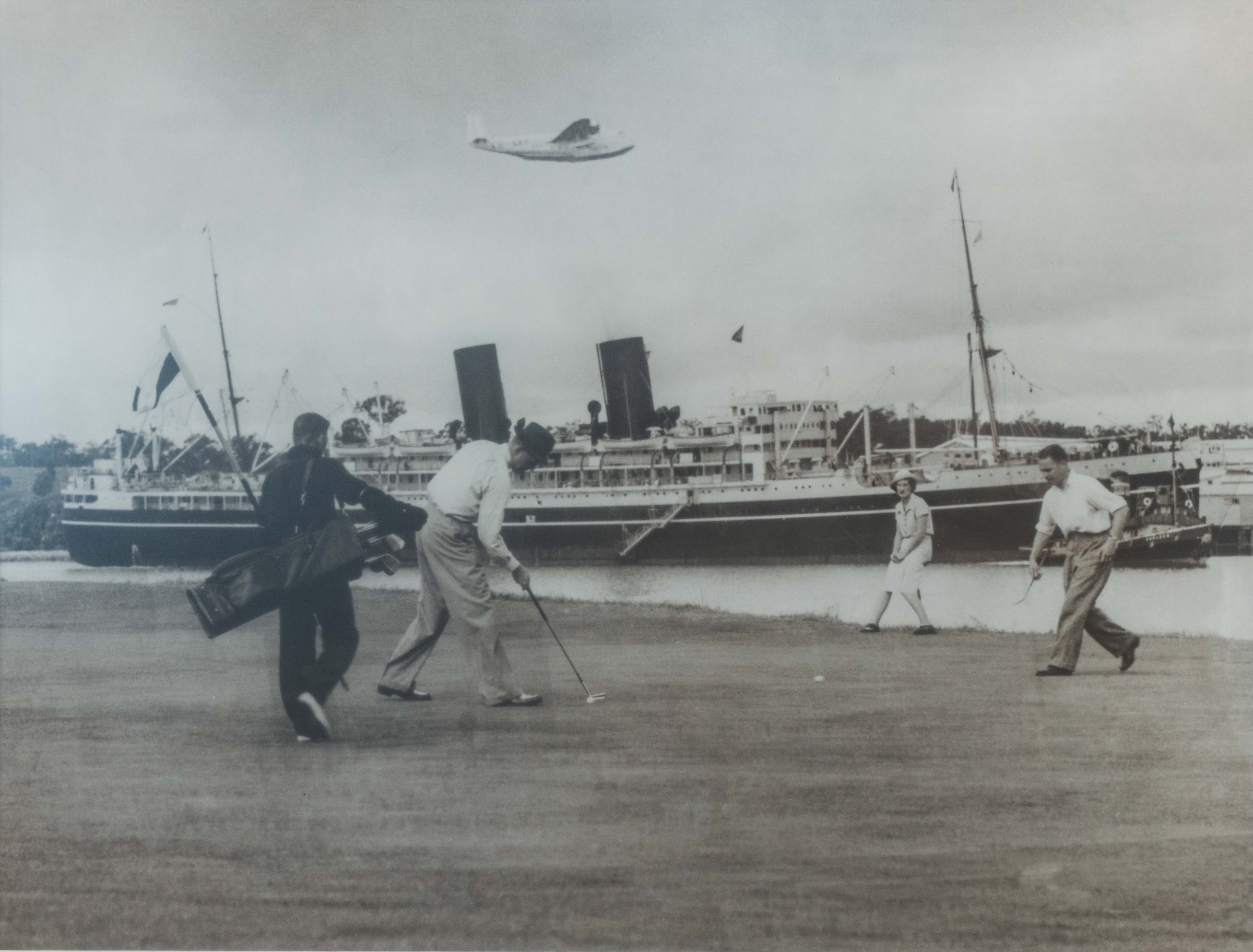
Golfers putting at Royal Queensland in the 1930s, a liner berthed on the Brisbane River behind them and a flying boat overhead

Section 1.0

The Brand

Royal Queensland Golf Club represents a century of championship golf on the Brisbane River.

Founded in 1920, we received our Royal title from King George V in 1921, with the King's approval conveyed to Queensland in a letter signed by Winston Churchill.

Since then we have played beside water that once carried passenger liners and flying boats, and in 2032 we will host golf at the Brisbane Olympic Games, the first Australian club to do so.

Reshaped by the river and the bridges that cross it, we have kept what matters: a course that asks real questions, a welcome without pretension, and a history worth carrying to the world.

1.1 Overview

Founded in 1920 on the banks of the Brisbane River at Eagle Farm, and granted its Royal title by King George V in 1921, Royal Queensland is Queensland's most decorated golf club and the confirmed venue for golf at the Brisbane 2032 Olympic Games.

Our original course was laid out on the sand and mangrove of Parker Island by Carnegie Clark, three-time Australian Open champion; refined after a 1926 visit from Dr Alister MacKenzie; and rebuilt in 2007 into the strategic championship course that has since hosted the Australian PGA Championship, today in the care of consulting architects OCM. We are a members' club with genuine championship pedigree, ten minutes from the city, on a bend of river that once carried passenger liners and flying boats.

We are a host, not a gatekeeper. For a century our members have made a hard, intelligent course feel like a welcoming home: a place where the golf asks real questions and the clubhouse gives an easy welcome. As we approach 2032, that balance is the point.

Serious about the game, relaxed about ourselves.

1.2 Manifesto

Our mission

To be the most respected golf club in Australia: a genuine championship test held to the highest standard, and welcoming enough that every member and guest feels they belong.

Our vision

To carry a century of Queensland golf history to the world stage in 2032 and beyond, as a club defined not by its Olympic moment but by the character, course and community that earned it.

Challenge

Royal Queensland is about to be seen by the world, and risks being known for one week in 2032 rather than a hundred years of substance. A Royal club can read as closed and formal; an Olympic venue can read as a stadium. Neither is who we are. The club has also grown beyond a single course. A championship layout, a new short course, an event space and a members' culture now sit side by side, without a clear system to hold them together.

Solution

We are telling the whole story, in our own voice. Not the longest course, not the loudest club: the thinking golfer's championship on the river, with a welcome to match its stature. We are building one coherent brand system, with a master brand of real authority, a members' mark for those who know us, and a short course that loosens the collar without letting go of the standard.

Result

A club that reads unmistakably as Royal Queensland whether you meet it on a scorecard, a clubhouse door, an Olympic broadcast or a Sunday afternoon at the short course. Because the clubs that last aren't built on prestige alone. They're built on a course worth the fight, a welcome worth remembering, and a history worth carrying forward.

1.3 Values

Royal

We wear our charter lightly. A Royal title is an honour, not a licence to be stuffy. We hold the standard high and our chins level. In practice: We honour the traditions worth keeping. We host heads of state and first-time guests with the same warmth. We let the history speak without lecturing. We never use the crown to keep people out.

Quality

The standard is the point. From the greens to the guest experience, we do things properly or not at all. In practice: Championship conditioning, every day. Considered detail over cheap flourish. Small, premium runs over mass-produced merchandise. We would rather do less, better.

Genuine

Host, not gatekeeper. Real Queensland warmth, no corporate polish, no manufactured mystique. In practice: Staff know members by name. Guests get a proper welcome, not a rulebook. We speak plainly. We are the same club on the first tee as in the last chair of the bar.

Custodianship

We hold this in trust. We are the current keepers of the river, the course and the club's future, including the next generation who will inherit it. In practice: We protect and rehabilitate the river frontage. We honour the design intent of every architect who has shaped the course. We build for members not yet born. We make room for families, juniors and new golfers.

1.4 Personality

Timeless authority, worn without pretension. Serious about the game, relaxed about ourselves. The quiet confidence of a club with nothing to prove.

Assured

We have a Royal charter, a century of history and an Olympic future. We don't need to raise our voice about any of it. Our confidence shows in restraint: in what we leave unsaid, and in a welcome extended rather than withheld.

Sharp

Our course rewards intelligence over strength; so does our brand. We are precise with detail, dry with humour, and quietly proud of members who understand why the fourth hole is hard. We think before we swing, and before we speak.

Warm

For all the gravitas, Royal Queensland is a Brisbane club: unstuffy, generous, quick to laugh. The river, the light and the Queensland climate make this a place people linger. We are the friend who happens to have the best address, not the neighbour who reminds you of it.

We never want to be

Stuffy, exclusionary or pompous. We never trade on the Royal title to make people feel small, never hide behind formality, and never let the Olympics become the only thing we talk about. We are not a stadium, not a museum, and not a members' club that forgot how to make a guest feel at home.

1.5 Voice

Our voice reflects who we are: warm without being casual, knowledgeable without being pretentious, confident without ever needing to prove it.

We are assured

We state facts and let them land. No superlatives, no straining.

"Royal Queensland has hosted three Australian Opens and will host the golf at Brisbane 2032."

"Experience the unrivalled prestige of Australia's most world-renowned Olympic golfing destination."

We are warm

We welcome people in, members and guests alike.

"Come in, take your time, and let us know if it's your first round with us."

"Access is strictly reserved for members and their approved guests at all times."

We are sharp

We reward the reader who understands the game.

"The fourth doesn't need length to defend itself. The angle off the tee decides everything."

"Our signature championship hole offers a truly unforgettable test for golfers of all abilities."

We are plain-spoken

Queensland-direct, no corporate fog.

"The short course is a handful of holes, a proper drink and a seat by the river. That's the idea."

"The facility leverages a multi-purpose hospitality ecosystem to maximise member engagement outcomes."

We are proportionate about 2032

The Olympics is a horizon, not the whole sky.

"2032 will be a proud week. The other fifty-one weeks a year are why we're ready for it."

"Everything we do is building to the Olympic Games."

1.6 Messaging

Primary message

A Century on the River. Ready for the World.

Royal Queensland Golf Club. On the river since 1920.

Supporting messages

  • A genuine championship test, rebuilt for the modern game.
  • A Royal title since 1921, worn without pretension.
  • A club on the river, shaped by a history of ships and flying boats.
  • From a first swing on The Knot to the championship tee.
  • Australia's first Olympic golf venue. Brisbane 2032.

Key proof points

  • Founded in 1920 as the Queensland Golf Club; granted its Royal title by King George V in 1921. The King's official letter of notification to the Governor of Queensland was signed by Winston Churchill, then Secretary of State for the Colonies.
  • Confirmed venue for men's and women's Olympic golf at Brisbane 2032, with the Games running 23 July to 8 August 2032 (International Golf Federation). Australia's first Olympic golf venue.
  • Host of three Australian Opens (1947, 1966, 1973). Arnold Palmer won the 1966 Australian Open here by five strokes from Kel Nagle, with a 20-under-par 276.
  • Host of the Australian PGA Championship in recent years. Jed Morgan won by 11 strokes in January 2022, the biggest winning margin in the championship's history, and Cameron Smith won his third PGA title here in November 2022.
  • Current championship course opened December 2007, with OCM as the club's consulting architects today. Ranked No. 36 nationally and Queensland's No. 1 course in Australian Golf Digest's Top 100 Courses 2024/25, and No. 1 in Queensland in Golf Australia Magazine's 2024 ranking.

1.7 Targeting

We speak to four audiences. Each hears a different emphasis of the same brand.

01

Next-generation members and families

The members and families who will carry the club to 2032 and beyond, including those who worry a Royal club is not for people like them.

What they value

  • A club that feels like home
  • Golf for all ages and abilities
  • Family-friendly social spaces
  • A path from beginner to member
  • Genuine warmth, and value in the experience rather than the address

Key message

Cradle to grave: there is a place for your whole family here, from the first putt to the championship tee.

How we reach them

  • Lead with The Knot as the welcoming front door
  • Show families and juniors, not only single-figure handicappers
  • Programs for beginners and women, and social membership pathways
  • Warm, plain-spoken member communications
02

The championship and architecture audience

Serious golfers, low-markers, architecture enthusiasts, and interstate and international visitors who travel for great courses and understand strategic design.

What they value

  • The course's strategic design and MacKenzie's legacy
  • Firm, fast, intelligent championship conditioning
  • Angles and options over brute length
  • Genuine tournament pedigree, and the chance to play an Olympic venue

Key message

A thinking golfer's championship, where the angle off the tee matters more than the number on the card.

How we reach them

  • Talk architecture with authority
  • Course guides and hole-by-hole strategy content
  • Lean on the PGA and Olympic pedigree
  • Position within a Queensland or Australian golf trip, with photography that reveals the design

03

Corporate, tournament and Olympic stakeholders

Sponsors, governing bodies, broadcasters, government and corporate partners connected to the club's tournaments and its Olympic future.

What they value

  • Global exposure and prestige
  • A credible, well-run championship venue
  • Proximity to the city and the airport
  • A compelling story for broadcast, and association with a Royal, Olympic institution

Key message

Australia's Olympic golf club: a century of pedigree, ten minutes from the city.

How we reach them

  • Professional, assured stakeholder communications
  • Lead with pedigree and readiness, not hype
  • Make the heritage a broadcast asset, the river, the ships and the flying boats
  • Keep 2032 in proportion: a proof point, not the whole pitch

04

The Knot's social audience

A younger, more social, more mixed audience. Beginners, women, families, and members who want golf and a good time rather than a card and a comp. See Section 7.0.

What they value

  • Relaxed, unintimidating golf
  • The river, the deck and the drink
  • Play that fits a busy life
  • A place with character, and a lower barrier to entry

Key message

Golf & Social. A short course, no fuss, right on the river.

How we reach them

  • The Knot's own lighter voice and extended palette
  • Social-led content and events
  • Lean on the retro river story
  • Welcome non-golfers to the pavilion

1.8 Historical

Architectural heritage

Carnegie Clark (1920–21): Australian Open champion who laid out the original course on reclaimed river sand, establishing the club's riverside character.

Dr Alister MacKenzie (1926): The most influential architect of golf's Golden Age, later of Augusta National and Cypress Point, who advised on greens and bunkering. Little of his specific work survives the 2007 rebuild, but the principles he championed (width, strategy, options over punishment) define the modern course.

The 2007 rebuild (Michael Clayton): With the Gateway Bridge about to be duplicated and the six eastern holes lost, the course was rebuilt as a strategic, MacKenzie-informed championship layout: wide fairways, centre-line and linear bunkering, large greens and preferred angles of approach. This is the course the world will see in 2032.

OCM (2020s): The club's consulting architects, stewarding the championship course and designing the new short course, The Knot, on the reclaimed Eastern Land, a homecoming to the club's original 1920 ground.

The MacKenzie legacy and the modern course

The club's design story is one of continuity through change. MacKenzie's brief 1926 visit left more philosophy than fabric. That philosophy, that golf should ask questions rather than punish mistakes, runs straight through the 2007 rebuild and into OCM's stewardship today. The result is a course that looks flat and plays deep: intelligence rewarded over power, angles over length.

1.8 Historical, continued

The river, the ships and the flying boats

Royal Queensland sits on the Hamilton reach of the Brisbane River, where the club's history is inseparable from the water. Through the 1920s and 1930s, Orient Line passenger liners, with their distinctive corn-coloured hulls and black-topped yellow funnels, berthed at the Hamilton wharves alongside the course.

From July 1938, Qantas Empire Airways' Short Empire flying boats operated to Singapore from a base near Hamilton and Pinkenba, taking off from the river. A famous archival photograph shows golfers on the course with a liner on the river behind and a flying boat overhead: the founding image of the club's colour palette and of The Knot.

Championship pedigree and 2032

Three Australian Opens, multiple Australian Amateur Championships and recent Australian PGA Championships have made Royal Queensland a proven championship venue. In 2032 it becomes Australia's first Olympic golf course: the horizon the whole club is preparing for, and a proof point rather than the point itself.

1.9 Timeline

A century on the river, in the moments that shaped the club.

1920–21

Founded as the Queensland Golf Club on a 420-acre lease at Parker Island, Eagle Farm. Carnegie Clark, three-time Australian Open champion, lays out the first course on sand dredged from the river.

1921

Opened by Governor-General Lord Forster on 12 August. King George V grants the Royal title; the letter of notification is signed by Winston Churchill, Secretary of State for the Colonies.

1923

A replica Silver Boomerang is presented to the Royal & Ancient Golf Club of St Andrews, which reciprocates with a replica of its 1754 Silver Club.

1926

Dr Alister MacKenzie visits in December and advises on greens and bunkering, calling the ground "excellently adapted" and fit to compare with the British championship courses.

1947

Hosts its first Australian Open, won by Ossie Pickworth.

1966 · 1973

Two more Australian Opens. Arnold Palmer wins the first by five shots from Kel Nagle; J. C. Snead takes the second.

1986

The Gateway Bridge opens across the club's land in January. Six holes now lie on the far side, and the course plays out under the bridge from the 12th tee and back beneath it from the 17th.

2005–10

The State confirms a second bridge in 2005, which will take the six eastern holes. Michael Clayton designs an all-new championship course on the clubhouse side, completed in December 2007. The duplicate opens in May 2010 and the eastern land sits idle.

2021

Brisbane confirmed as 2032 Olympic host, and Royal Queensland as the golf venue, Australia's first.

2022

Hosts the Australian PGA Championship twice: Jed Morgan wins by a record 11 shots in January, Cameron Smith takes his third title in November.

2024–26

Masterplan approved by Ministerial Infrastructure Designation. The Eastern Land, unused since the duplication, is reclaimed for The Knot short course, a riverside pavilion and Olympic-standard upgrades.

Section 2.0

Brandmarks

2.0 Our Emblem

The crowned Q

Our emblem is a golf club passing through the letter Q, beneath a crown: the historic device of Royal Queensland, carried forward from the club's own archive. The Q stands for Queensland, the club's founding name; the club, for the game; the crown, for the Royal title granted in 1921. It is the oldest continuous signature of the club we could find, and we have kept it.

Continuity, not reinvention

We have not redrawn the club's history. The crowned-Q device is retained largely as it has long appeared, refined only for reproduction, and paired with a new wordmark set in an elegant serif. The wordmark adds contemporary poise; the emblem keeps the line back to the club's beginnings unbroken.

A mark worn lightly

The crown signals honour, not exclusion. Used well, the emblem carries a century of pedigree with quiet confidence. It should feel earned and understated. Never loud, never a barrier.

2.1 Logo Alternates

Emblem

The club's primary signature. Use where the audience already knows Royal Queensland, and for crests, flags, signage and formal applications.

Primary lockup

The default for most external applications. Use where the club must be named and recognised.

Wordmark

For contexts where the emblem is impractical or already present nearby. The elegant serif carries the brand on its own.

Members' monogram

Reserved for members and member-only applications. The inside mark (see Section 6.0). Never the public-facing primary logo.

Club shield

Used where added historic context and a traditional look feels appropriate.

The Knot

The endorsed sub-brand's own suite (see Sections 6.0 and 7.0). Governed by The Knot's guidelines, locked back to the master brand by the endorsement rules.

Full lockup
Wordmark
Members' monogram
Emblem
Club shield
The Knot Golf & Social

Full lockup

Full lockup, reversed

Emblem

Emblem, reversed

Wordmark

Wordmark, reversed

Members' monogram

Members' monogram, reversed

Club shield

2.2 Clearspace and size

Clearspace

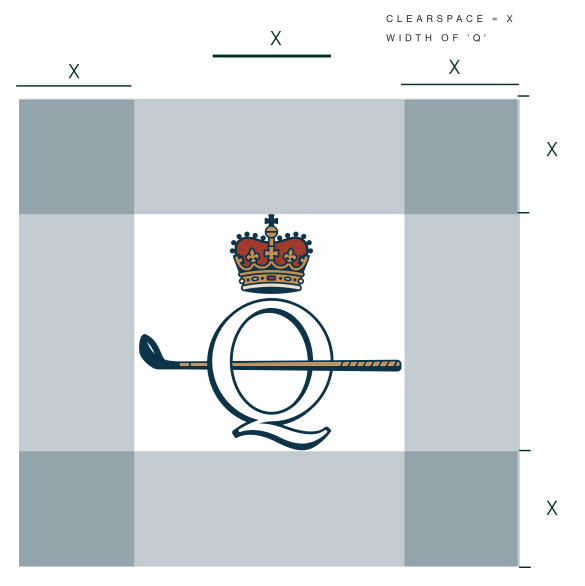
Keep clear space around every mark equal to the width of the Q in the emblem, on all four sides. Nothing enters that field, including type, rules, image edges and other marks. On the wordmark alone, measure X from the Q in Queensland.

Minimum size

  • Full lockup: 300 px wide on screen, 30 mm in print
  • Emblem: 50 px, 8 mm
  • Wordmark: 200 px, 20 mm
  • Members' monogram: 40 px, 6 mm
  • Embroidery and etching need more. Below these sizes the crown fills in and the club loses its line.

Maximum size

There is no upper limit. Above two metres wide, work from the vector master and check the crown and club line weights on a proof before the run.

Placement

Give the marks room and a clean ground. Prefer Paper, Cream or Ink fields, and avoid busy photography behind the mark. Use the reversed emblem on dark grounds.

The emblem inside a square of clear space, each side marked X, where X is the width of the Q
Clearspace equals X, the width of the Q

Section 3.0

Colour

3.1 Where the colour comes from

Our palette is drawn from two sources held together. The club's existing colours, a deep navy, a red and a gold. And the river imagery of the 1920s and 1930s, especially the archival photograph of golfers, a liner and a flying boat that anchors The Knot.

The master brand

Leads with Ink, Gold and Signal Red on Paper, Cream or Black. Mostly navy and paper, with gold for detail and red in small doses. Disciplined, formal and quiet. The fewer colours on a master brand piece, the more it looks like the club.

The Knot

Draws on the same foundation but opens into a wider, more playful set. Petrol from the tidal river, Sage from the salt marsh, Funnel from the yellow stacks of the liners. These three never appear on master brand work.

Ownership

Ink, Cream, Black and Paper are the shared foundation. Gold is the master brand's alone. Petrol, Funnel and Sage belong to The Knot's extended set. Signal Red is shared, sparingly. Colour is one of the clearest signals of which brand is speaking.

How to read the pages that follow

3.2 gives every colour its numbers. 3.3 opens each one into tints, shades and opacities. 3.4 shows which pairings may carry text, with the contrast measured. 3.5 draws the line between the two brands.

3.2 The palette

Nine colours. Four grounds and inks shared across the system, two master brand accents, three for The Knot. Hex and RGB for screen; CMYK and Pantone for print.

Ink #0C3347
RGB
12 51 71
CMYK
83 28 0 72
Pantone
302 C
Role
Primary · text and mark

The deep navy the club has long worn. The master brand, the wordmark, body text and formal applications. Never pure black.

Paper #F7F2F0
RGB
247 242 240
CMYK
0 2 3 3
Pantone
No match · CMYK on uncoated stock
Role
Ground

A soft, warm off-white. The everyday ground for the master brand and the page most things start on.

Black #1B1D1C
RGB
27 29 28
CMYK
7 0 3 89
Pantone
Neutral Black C
Role
Ground · reverse

A near-black for dark grounds, signage and apparel. Softer than pure black, with no blue in it.

Cream #E7DFC8
RGB
231 223 200
CMYK
0 3 13 9
Pantone
7506 C
Role
Heritage ground · reverse ink

An aged, archival cream from vintage paper and ticket stock. The mark and text on dark grounds; a heritage accent for the master brand.

Gold #C29053
RGB
194 144 83
CMYK
0 26 57 24
Pantone
7407 C
Role
Master accent · the club's gold

The club's gold, warmed to an aged, metallic tone. Detail, emphasis and premium applications. A substitute for foil.

Signal Red #A13B2C
RGB
161 59 44
CMYK
0 63 73 37
Pantone
7599 C
Role
Accent · emphasis

Competition and emphasis, in small doses. Never as a field colour, never on the logo.

Petrol #2E4B59
RGB
46 75 89
CMYK
48 16 0 65
Pantone
7546 C
Role
Knot accent · the river

A deep blue-green of tidal water. The bridge between Ink and The Knot's lighter tones.

Sage #B5CCB0
RGB
181 204 176
CMYK
11 0 14 20
Pantone
7485 C
Role
Knot accent · the turf

A soft, dusty green from the salt marsh and the rehabilitated river frontage. Course-facing work.

Funnel #F4C23B
RGB
244 194 59
CMYK
0 20 76 4
Pantone
122 C
Role
Knot accent · the stacks

Pulled from the black-topped yellow funnels of the Orient liners. The Knot's social and wayfinding accent. Never on the master brand.

CMYK values are derived from the hex and are a starting point for press. Pantone references are the closest coated match and must be proofed against a current swatch book before any run.

3.3 Tints and shades

Each colour opened out into the steps it may be used at. Six tints toward white, the base, three shades toward black, and five opacities over Paper. Use a step, not a colour picked by eye.

Ink#0C3347

100 200 300 400 500 600 Base 800 850 900
8% 16% 32% 56% 80%

Paper#F7F2F0

100 200 300 400 500 600 Base 800 850 900
8% 16% 32% 56% 80%

Black#1B1D1C

100 200 300 400 500 600 Base 800 850 900
8% 16% 32% 56% 80%

Cream#E7DFC8

100 200 300 400 500 600 Base 800 850 900
8% 16% 32% 56% 80%

Gold#C29053

100 200 300 400 500 600 Base 800 850 900
8% 16% 32% 56% 80%

Signal Red#A13B2C

100 200 300 400 500 600 Base 800 850 900
8% 16% 32% 56% 80%

Petrol#2E4B59

100 200 300 400 500 600 Base 800 850 900
8% 16% 32% 56% 80%

Sage#B5CCB0

100 200 300 400 500 600 Base 800 850 900
8% 16% 32% 56% 80%

Funnel#F4C23B

100 200 300 400 500 600 Base 800 850 900
8% 16% 32% 56% 80%

Steps are named the way a developer will call them, 100 to 950. The base is outlined. Opacities are for washes and rules over Paper only.

3.4 Two brands, one palette

The bars show which colours each brand may draw on. Shared colours run the full width. A colour on one side only never crosses the line.

Master brand

Master brand

Ink on Paper, Gold for detail, Signal Red for emphasis, Cream and Black for heritage and reverse. Gold is the master brand's alone; it is what makes a piece read as the club rather than the course.

Master onlySharedThe Knot only

Gold
Funnel
Sage
Petrol
Ink
Cream
Signal Red
Black
Paper

The Knot

The Knot

The same foundation, opened out with Petrol, Sage and Funnel. Playful where the master brand is restrained. The Knot never borrows Gold, and the master brand never borrows the three accents.

3.5 Pairings

The combinations that may carry text, with the contrast measured. AA and above may hold body copy. Display only means the mark or large type, never a paragraph.

Aa Ink on Paper The default. Body copy

12.0 : 1 AAA

Aa Paper on Ink Reverse. Covers

12.0 : 1 AAA

Aa Cream on Black The dark ground. Apparel

12.7 : 1 AAA

Aa Ink on Cream Heritage print. Menus

10.0 : 1 AAA

Aa Gold on Ink Premium detail. Rules

4.7 : 1 AA

Aa Gold on Black Premium only. Milestones and member gifts.

6.0 : 1 AA

Aa Signal Red on Paper Emphasis. A word

6.0 : 1 AA

Aa Paper on Signal Red Rare. Competition panels and tags.

6.0 : 1 AA

Aa Cream on Petrol The Knot only. Where the course meets the water.

7.0 : 1 AA

Aa Ink on Sage The Knot only. Course diagrams

7.7 : 1 AAA

Aa Ink on Funnel The Knot only. Wayfinding and social.

8.0 : 1 AAA

Aa Signal Red on Cream Heritage emphasis. A stamp

5.0 : 1 AA

Contrast is measured to WCAG 2.1. Ratios below 3 to 1 are not shown, because they are not pairings. Petrol, Sage and Funnel pairings belong to The Knot alone, as the previous page sets out.

Section 4.0

Application

4.0 Application

Monogram with type and pattern

The RQ members' monogram is at its best small, quiet and beautifully made: embossed, embroidered or foil-blocked on member applications. Pair it with the serif wordmark and generous space. Never crowd it, never blow it up, never explain it. Its power is that members already know.

Photography

Royal Queensland's photography is about river, light, era and people. Shoot the low, warm Brisbane light; the water and its traffic; the course's strategic lines; and, crucially, real members and guests, not stock golfers. Black-and-white and warm, aged tones connect the modern club to its 1920s and 1930s heritage. Avoid clichéd hero-golfer-at-sunset imagery. Favour atmosphere, place and genuine welcome.

Patterns and graphic devices

The master brand's devices are the crown, the Q and the maritime signal flags flown on the course. The Knot's devices are the rope, the reef knot, the hand-drawn knot-tying diagram and the flying boat. Keep the two families distinct: crown and Q for the master brand; rope, knot and flying boat for The Knot.

Club badge

The crowned-Q emblem is the club badge, for blazers, caps, flags and honour boards. Reproduce it faithfully at a generous size, in Ink, Gold or single-colour on Cream. This is the most formal expression of the brand. Treat it with restraint.

4.0 Application, continued

Print

Set the master brand in the serif wordmark on Paper or Cream, with Ink text and sparing Gold and Signal Red accents. Generous margins, considered typography, quality stock. Print should feel like the club: understated, well-made, confident.

Merchandising

Premium, small runs, tightly controlled: quality over volume. Colour-match to the palette so the pro-shop range reads as one considered collection, not a patchwork of supplier reds and blues. Master brand merchandise leads with the emblem and Ink and Gold; The Knot's range uses its own marks and extended palette (see Section 7.0). No generic accessories. No external supplier branding on garments.

Around the club

Wayfinding, signage and course furniture should be quiet and consistent: Ink and Cream, the serif wordmark, the emblem used sparingly and always with room. Let the river and the course be the hero. Let the brand guide, not shout.

Section 5.0

Typography

5.0 Typography

Our typography balances heritage and modern elegance. The master brand favours a refined serif for authority and grace; The Knot uses a warmer, more characterful set for its lighter voice.

Display and wordmark

P22 Mackinac Pro

The master brand wordmark and headlines, and the face The Knot's logotype is drawn in. Timeless and assured: traditional but not dated, refined but not fussy. The wordmark itself ships as artwork and is never re-set as live text.

Served · Adobe Fonts

Aa

Royal Queensland

Headings and labels

Neue Haas Grotesk Display

Section numbers, headings and structural labels, in 45 Light and 65 Medium. The grotesk gives the serif something to sit against without competing with it.

Specified · shown in Helvetica Now until the kit carries it

Aa

1.1 Overview

Body

Calluna

Body and supporting text. Clean and highly legible, quiet enough to let the display face lead.

Specified · shown in Mackinac Book until the kit carries it

Aa

Serious about the game, relaxed about ourselves.

Accent and data

DM Mono

A widely tracked monospace for labels, sub-lines and data. A contemporary, technical counterpoint, always uppercase.

Served · Google Fonts

Aa

RQGC BRAND GUIDE V1.0

Hand-drawn accent

Chippewa Falls

Reserved for The Knot's knot-tying diagram lockup only. Never for body text, and never longer than about four words.

The Knot only

Aa

See you at the crossover

Section 6.0

Brand Architecture

6.0 Brand Architecture

One club, three marks. Each has a job, and the jobs do not overlap.

(a) Royal Queensland Golf Club · the master brand

The club's full authority. Leads on the championship course, the clubhouse, tournaments, the Olympics and formal member communications. Rigid and singular; every other mark borrows from it.

(b) RQ members' monogram

The inside mark. Member cards, member apparel, gifts, honour boards and correspondence. Never the public-facing logo, never in visitor or commercial marketing, never explained.

(c) The Knot · endorsed sub-brand

The social short course. Its own name, mark, extended palette and lighter voice, always beneath Royal Queensland. Leads on the short course, the pavilion, social events and lifestyle merchandise.

The endorsement

The Knot is always by, or at, Royal Queensland Golf Club. In formal, function and first-mention contexts the endorsement is explicit. The two marks keep their own artwork and are never fused into one lockup. The Knot borrows the master brand's foundation colours and never its Gold.

A fourth entity, the club's event space, is anticipated as its own sub-brand and joins the architecture when named.

Section 7.0

The Knot

7.0 The Knot · Golf & Social

A new short course by OCM on the reclaimed Eastern Land, the site of the club's original 1920 course. A genuine homecoming. Golf loosened up: relaxed, social, age-agnostic, and unmistakably of Royal Queensland.

Purpose

The club's welcoming front door. Where a member brings the family, a beginner takes a first swing, and a group comes for the river, the deck and the drink as much as the golf. Cradle to grave.

Personality

Playful. A wink, not a lecture. Social. Golf is the reason to gather; the gathering is the reason to stay. Characterful. Retro, river-born and specific: steamships, flying boats, hand-drawn knots.

Voice

Warmer, lighter and more playful than the master brand, but never sloppy.

"A short loop, a putting green the size of a paddock, and a cold one by the river. Bring the kids."

"Experience an unparalleled premium short-course lifestyle destination."

Relationship to Royal Queensland

Endorsed by, and drawing its authority from, the club. It shares the values, the quality standard, the river heritage and the foundation colours, and loosens the rest. Always of Royal Queensland, never a separate club, never a diminished one.

8.0 Files

The complete brand kit

Every Royal Queensland and Knot mark in SVG, EPS and PNG, with the palette and type specification. One ZIP, for suppliers and the club alike.

Primary lockup

Primary lockup, reversed

Emblem

Emblem, reversed

Wordmark

Members' monogram

Club shield

The Knot

Every link is a direct download. SVG is the master format; every EPS and PNG is made from it with no transforms or clipping, so they open the same way in Illustrator, Affinity, Canva and a browser. The wordmark and monogram are supplied in Ink here and in Cream in the kit.

Serious about the game, relaxed about ourselves.

Contours · Creative Golf Agency

will@contours.agency

01 / 43

PDF